How the World Eats / Chapter 7 of 8
How prices are setBenchmarks, futures, auctions, tenders, stocks, and the forces from outside food
Every shock in the food system eventually becomes a number. Understanding where those numbers come from, and which ones matter, is the difference between reading a market and guessing at it.
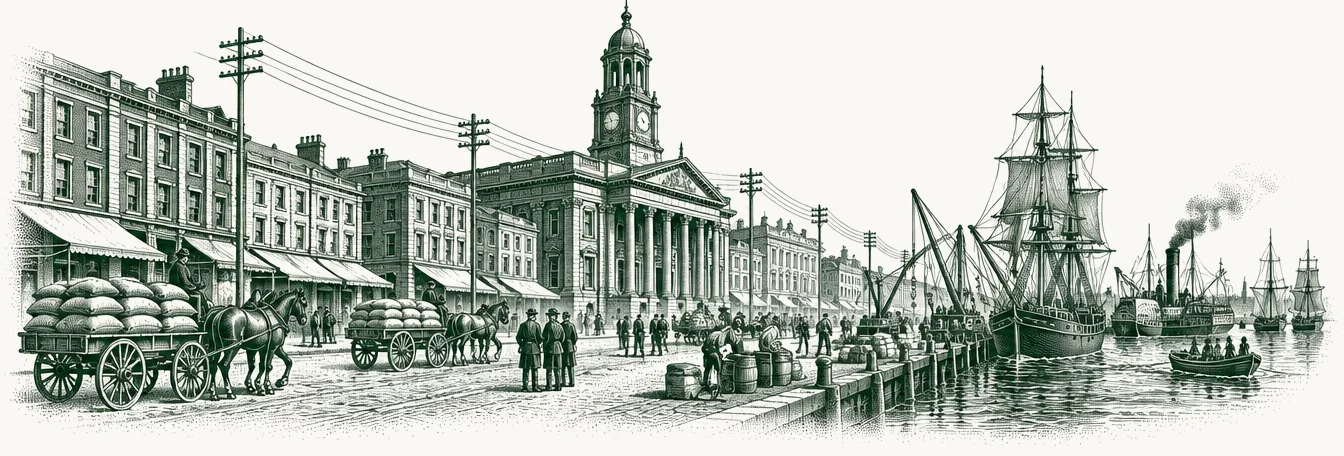
One food, many prices
There is no single price for wheat, beef or milk. There are many, at different points along the chain.
- The benchmark price is set on a futures exchange or at an auction. It is the reference everyone watches.
- The farmgate price is what the farmer receives.
- The FOB price is the price at the export port, loaded onto a ship (Chapter 1).
- The CIF price is the price delivered to the importing port, including freight and insurance.
- The wholesale price is what processors, retailers and caterers pay in the importing country.
- The retail price is what the shopper pays.
These prices move together, but not in lockstep. The gaps between them reflect transport, quality, processing, margins, taxes and currency. Much of the analysis in GFO signals is about those gaps: why a farmgate price has not followed a rise in the benchmark, or why the landed cost in one import market has risen faster than in another.
The price ladder
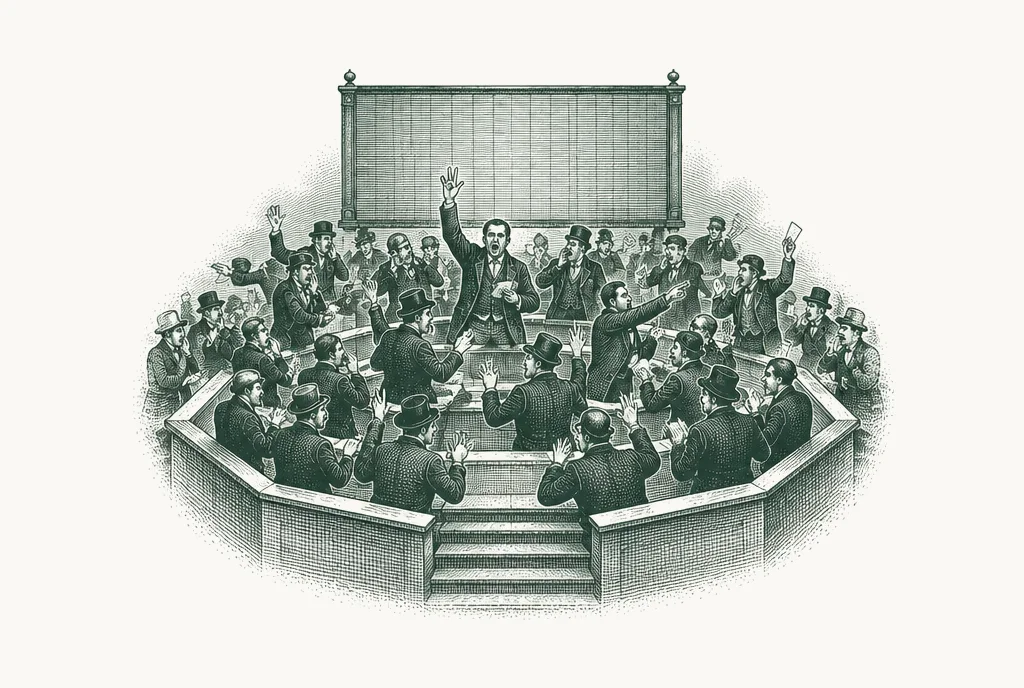
Futures marketswhere most benchmarks are set
- Where
- Chicago, Paris, New York, London, Kuala Lumpur, Dalian
- Used by
- Hedgers and speculators
- Key idea
- Futures set the level; basis sets the local price
A futures contract is an agreement to buy or sell a set quantity of a commodity, of a set quality, at a set price, on a future date. Futures are traded on exchanges, and their prices are published continuously.
Why they matter. For the commodities that have them, futures are the main way prices are discovered. They bring together buyers and sellers from around the world, and they react instantly to news: a weather forecast, a crop report, a policy announcement.
The main contracts. The best-known agricultural futures include corn, soybeans, soybean meal, soybean oil and wheat in Chicago; milling wheat and rapeseed in Paris; raw sugar, coffee and cocoa in New York and London; palm oil in Kuala Lumpur; and soybean meal, corn and other products in Dalian and Zhengzhou in China. Dairy and livestock futures also exist, but are generally less widely used internationally.
Who uses them. Two broad groups. Hedgers are businesses exposed to the physical commodity: farmers, merchants, processors and food manufacturers. They use futures to lock in prices and protect themselves from price swings. Speculators, including investment funds, trade futures to profit from price movements. They take on the risk that hedgers want to shed, and they add trading volume. They can also add to price swings when many move in the same direction.
Basis. The price in a particular place is rarely the same as the futures price. The difference is called the basis. It reflects local supply and demand, transport costs and quality. A merchant might buy wheat from a farmer at "futures minus 30 cents", or sell soybeans to an importer at "futures plus a premium". Traders often say that futures set the level and the basis sets the local price.
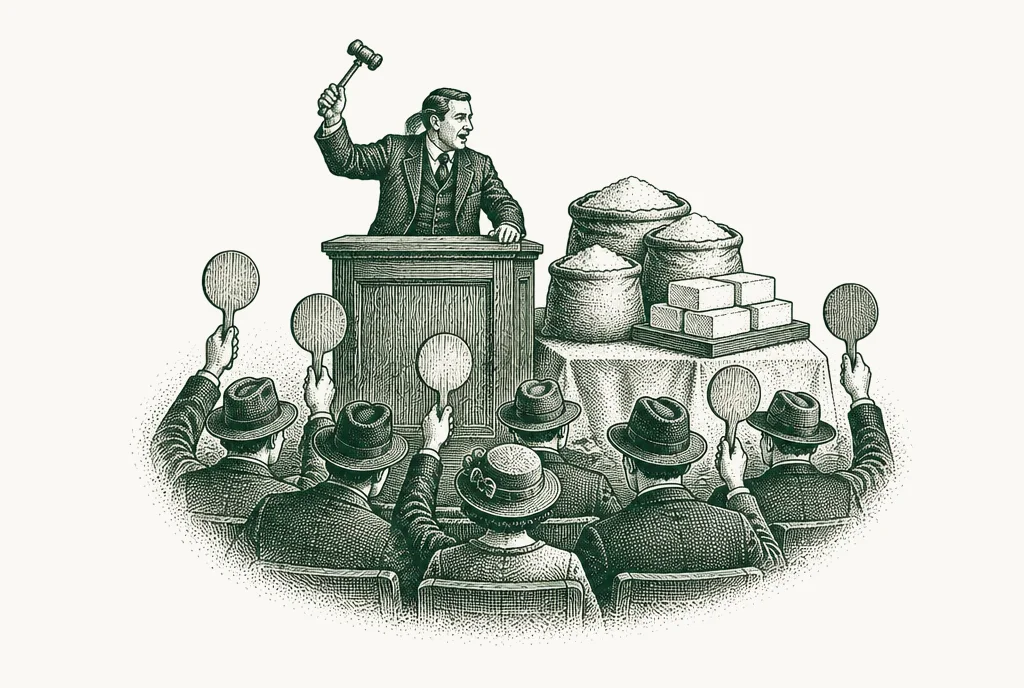
Auctionsprices discovered in public
- Best known
- Global Dairy Trade
- How
- Ascending-price bidding rounds
- Why watched
- A public signal for world dairy prices
Some markets discover prices through regular public auctions.
The best-known in food is Global Dairy Trade (GDT), an online platform for selling dairy commodities such as whole milk powder, skim milk powder, butter and cheese. Its main trading events are held twice a month, on the first and third Tuesday 1. They are run as ascending-price auctions over several bidding rounds: the price rises until demand matches the quantity on offer 3.
GDT is dominated by New Zealand's Fonterra, and New Zealand is one of the largest dairy exporters. That makes its results a widely watched signal of where international dairy prices are heading, even though most dairy is sold outside the auction.
Auctions are also used for fish, some fresh produce, tea, wool and livestock in many countries, often at a local or regional level.
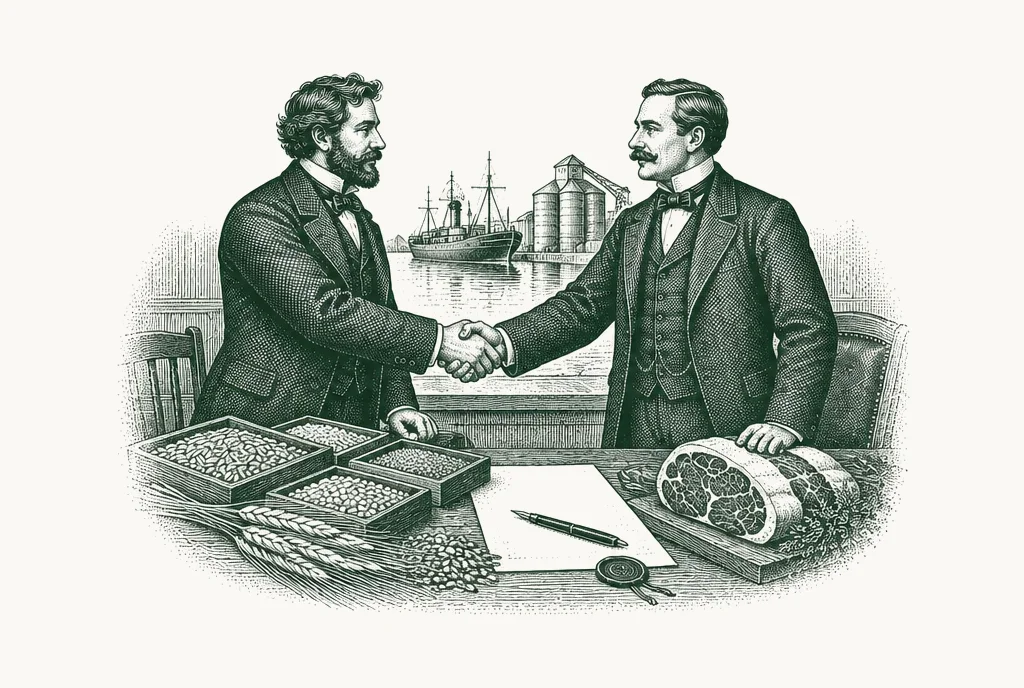
Negotiated priceshow most food is actually sold
- Common for
- Meat, seafood, produce, processed food
- Visibility
- Low: deals are private
- Reference
- Price reporting agencies and indices
Most food is not traded on exchanges or at auctions. It is sold through private negotiation between buyer and seller.
This is the norm for meat, most seafood, most fresh produce, processed foods and many dairy products. Prices are agreed in individual deals or in contracts that run for months or years. They often reference a benchmark or an index, with a premium or discount for quality, origin, specification and timing.
Because these prices are private, they are harder to see. The market relies on price reporting agencies, trade publications and government market reports that survey buyers and sellers and publish assessed prices. Those assessments become the reference points for further deals.
Long-term contracts. Many food companies and retailers buy under contracts that fix volumes and set pricing formulas in advance. This smooths out volatility for both sides, but it also means that changes in spot prices can take months to reach contract prices.

Tendershow governments buy
- Who
- State buyers in importing countries
- What
- Wheat, rice, sugar, vegetable oil
- Why watched
- Large volumes and published results
Many importing countries buy staple foods through state tenders. A government agency announces that it wants to buy a certain quantity of wheat, rice, sugar or vegetable oil, for delivery over a set period. Exporters submit offers, and the agency buys the cheapest acceptable ones.
State tenders are common in North Africa, the Middle East and parts of Asia. They are watched closely for two reasons. First, the volumes are large, so a single tender can move a market. Second, the results are often published, which gives the market a rare public view of the prices at which exporters are willing to sell, and which origins are most competitive.

Every shock in the food system eventually becomes a number.
The fundamentalssupply, demand and stocks
- Key report
- USDA WASDE, every month
- Key number
- The stocks-to-use ratio
- Caution
- Global stock figures can mislead
Underneath all of these mechanisms, prices respond to the balance between supply and demand. Analysts track that balance through balance sheets: estimates of production, consumption, trade and stocks for each commodity, by country and for the world.
The most influential are the US Department of Agriculture's monthly World Agricultural Supply and Demand Estimates (WASDE), along with outlooks from the FAO, the International Grains Council and national governments. A surprise in a WASDE report can move futures prices within seconds.
The single most useful number on a balance sheet is the stocks-to-use ratio: ending stocks divided by annual consumption. It shows how big the cushion is. For example, the world rice stocks-to-use ratio averaged 26.96% in 2018–2020 4, meaning stocks equalled roughly a quarter of a year's use.
When the ratio is high, the market can absorb a poor harvest, and prices tend to be calm. When it is low, even a small shortfall can send prices sharply higher. This is the buffer idea from Chapter 6, expressed as a number.
One caution: global stock figures can mislead. A large share of the world's stocks of some grains is held in China, and is not generally available to the world market. Analysts often look at stocks held by major exporters as a better guide to how tight world trade really is.
Outside forcesthe dollar, energy, freight and money
- The dollar
- Most traded food is priced in US dollars
- Energy
- Fertiliser, fuel and biofuels
- Money
- Interest rates and investment funds
Food prices are not set by food markets alone. Four outside forces matter a great deal.
The dollar. Most internationally traded food commodities are priced in US dollars. When the dollar strengthens, food becomes more expensive for buyers paying in other currencies, and demand can soften. When an importing country's currency falls against the dollar, its food import bill rises even if world prices are flat.
Energy. Energy feeds into food prices in several ways: through fertiliser (especially nitrogen, made from natural gas), fuel for farming and transport, processing costs, and biofuels, which link corn, sugar and vegetable oil prices to oil prices (Chapters 2 and 5).
Freight and insurance. The cost of moving food changes the price at which it arrives (Chapter 4). When freight rates rise, the gap between FOB and CIF widens, and the most distant suppliers lose competitiveness.
Money and investors. Interest rates affect the cost of holding stocks, and so how much traders are willing to store. Investment funds move money into and out of commodities, which can add to price swings in the short term.
Price indices
To see the big picture, analysts use price indices that combine many prices into one number.
The most widely cited is the FAO Food Price Index, published monthly. It tracks international prices for five groups of commodities: cereals, vegetable oils, dairy, meat and sugar, measured against a base period of 2014–2016 set at 100 (FAO). It reached a record 159.3 points in March 2022 2.
The World Bank, the IMF and national statistics offices publish other indices. For consumers, the most relevant measure is food inflation: the change in retail food prices in each country, which often behaves very differently from world commodity prices.
From world price to shopping basket
Changes in world prices do not reach consumers quickly or fully.
The lag. It can take months for a rise in commodity prices to reach supermarket shelves, because of contracts, stocks already in the chain, and processing time.
The dilution. In high-income countries, the raw commodity is a small share of the retail price. As Chapter 1 showed, US farms received 11.8 cents of each dollar spent on domestically produced food in 2024 5. Labour, energy, packaging, transport and retail margins make up the rest, so a doubling of the wheat price does not double the price of bread.
The asymmetry. Prices often rise faster than they fall. Retailers and processors pass on cost increases quickly, but are slower to pass on decreases, especially when other costs such as wages and energy are rising.
In lower-income countries, where people spend a larger share of income on food and buy it less processed, world price changes pass through faster and hit harder.
How to use this when reading signals
When a GFO signal reports a price move, ask:
- Which price is it? A futures benchmark, an auction result, a tender, a farmgate price or retail inflation each tells a different story.
- What is driving it? A change in fundamentals, a change in an outside force such as the dollar or energy, or a shift in investor positioning.
- Is it passing through? Check whether the move is reaching import costs, farmgate prices and retail prices, and how quickly.
Chapter 8 collects the terms used throughout this guide in a single glossary.
Sources
- CRA International, announcement of GDT Pulse Auctions, 3 August 2022.↩
- FAO, Food Price Index release, 8 April 2022.↩
- Irish Farmers Journal, "What is the GDT and how does it work".↩
- University of Arkansas, International Rice Outlook 2021–2031, 2021.↩
- USDA ERS, Food Dollar Series, updated 10 March 2026.↩
Last reviewed 21 September 2026
See the system move, every week.
GFO's weekly signal summary tracks the developments that matter across price, trade, supply, biosecurity, regulation and climate. Free, no card required.